

Selecting the Best Bulk Cargo Discharging Company in Iranian Ports
A Comprehensive and Strategic Guide for Cargo Owners and Logistics Managers
Success in international trade and the domestic supply chain depends on making precise decisions at the country’s points of entry and exit. Among the various stages of maritime transport, the process of bulk cargo discharging is of strategic importance due to the high volume of shipments, the physical sensitivity of goods, and the critical dependence on time. Even delays of only a few hours in berthing and discharging bulk carriers can result in substantial demurrage costs and truck idle-time expenses. Accordingly, selecting a first-tier contractor for bulk cargo discharging operations in Iranian ports is a mission-critical decision for preserving both profitability and cargo integrity.
In this competitive and complex market, Baareman Company has secured the leading position as the foremost and best-equipped specialist provider of bulk cargo discharging services in Iranian ports, relying on modern infrastructure, expert operational teams, and optimized time management.
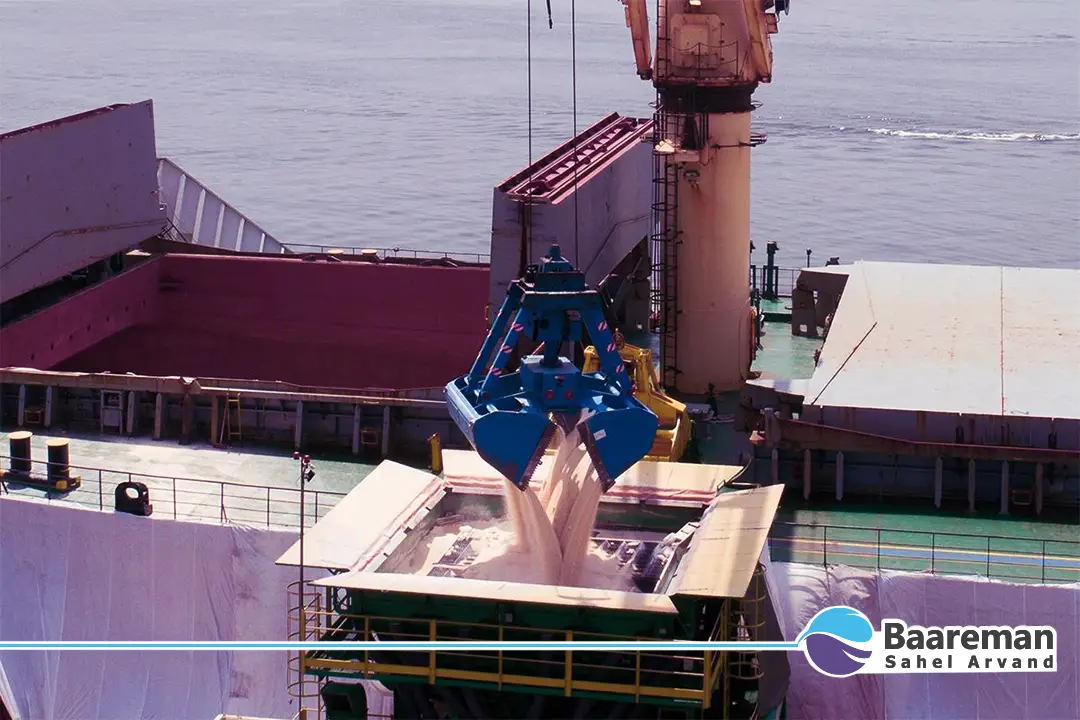
The Strategic Importance of Bulk Cargo Discharging Operations in the Supply Chain
Bulk cargo encompasses a wide range of essential commodities and industrial inputs, including grains (wheat, corn, barley), minerals (iron ore, clinker, sulfur), chemicals, and petrochemical products, all transported unpackaged and in very high tonnages. These commodities are highly vulnerable to environmental factors such as humidity, wind, rain, and cross-contamination. For this reason, bulk discharging requires advanced equipment and exceptional execution speed.
In the Ports of Iran, managing this process entails particular complexity due to operational constraints and the need to coordinate with multiple regulatory bodies. Any lack of planning in berthing schedules or reliance on worn-out equipment immediately translates into financial losses for the cargo owner. With a full understanding of these sensitivities, Baareman delivers services that go far beyond routine discharging, functioning instead as a protective shield for the capital of importers and exporters.
The Critical Role of Bulk Cargo Discharging in the National Economy
Bulk cargo—whether minerals, grains, petrochemical products, or animal feed inputs—has a distinct operational profile that differentiates its handling from other categories of goods. Unlike containerized cargo, which is secured in standardized packaging, bulk cargo is carried loose in the vessel’s holds, and its discharge requires dedicated equipment, technical expertise in material flow angles, dust control, contamination prevention, and execution within limited time windows. Any unjustified interruption in the discharging process not only increases port-related costs but can also compromise product quality and jeopardize your commercial relationships with end buyers.
Recognizing that bulk discharging in Iranian ports constitutes the operational front line of trade, Baareman has designed its infrastructure to minimize all such risks. A review of actual port operations demonstrates that the principal distinction between ordinary contractors and a top-tier operator such as Baareman lies in the management of both “time” and “quality.” While many contractors focus merely on physically completing the work, Baareman’s approach is grounded in process engineering, significantly reducing vessel port-stay duration.
Challenges of Bulk Cargo Discharging in Iranian Ports
Managing port operations in Iran involves unique challenges that only companies with extensive field experience can successfully navigate. Infrastructure limitations in certain terminals, fluctuating weather conditions, complex coordination among customs, the Ports and Maritime Organization, and the need for rapid discharge all represent factors that, if handled by an inexperienced team, may lead to irreparable losses.
One of the most significant issues in this sector is equipment wear and the failure to apply modern knowledge to cargo transfer from vessel to transport vehicle. If bulk cargo is discharged without adherence to safety protocols, it may result in excessive spillage, environmental contamination, and damage to the ship’s structure. By relying on modern discharging equipment and highly specialized personnel, Baareman manages the process in a manner that preserves cargo integrity while maintaining the highest levels of personnel and equipment safety. This comprehensive perspective is precisely what differentiates Baareman from its competitors and makes it a dependable choice for industrial stakeholders.

Criteria for Selecting the Best Bulk Cargo Discharging Company
Cargo owners and logistics managers should not base contractor selection solely on the nominal prices shown on quotations. In trade, low-cost discharging often carries far heavier hidden costs. For an accurate evaluation, the following factors should be treated as core assessment criteria:
- Operational experience in the Ports of Iran: The company must have a sustained operating history in major terminals such as Shahid Rajaee Port and Imam Khomeini Port and must be familiar with local regulations and the constraints of each terminal.
- Equipment fleet: Access to modern discharging machinery, such as various types of grabs and conveyors suited to the cargo type and vessel capacity, is essential.
- Technical team structure: The ability to manage manpower effectively and coordinate precisely with port teams in order to prevent operational bottlenecks.
- Safety record and insurance coverage: The capacity to deliver services with low risk and to manage unforeseen incidents effectively.
- Reporting and transparency: The provision of precise, real-time documentation regarding discharged tonnage and operational speed to the principal.
Baareman delivers reliable and standardized performance across all of these indicators. Many companies may be capable of covering some of these requirements, but what establishes Baareman as the best option is its consistency in delivering quality across every project.
Key Challenges in Bulk Cargo Discharging Operations at Border Terminals and Iranian Ports
Managing bulk cargo discharging in Iranian ports involves numerous technical and bureaucratic challenges. Understanding these challenges enables logistics decision-makers to calibrate their evaluation criteria with greater precision:
- Time management and demurrage prevention: The daily cost of idle ocean-going vessels is extremely high. Any technical failure in discharging equipment or lack of coordination with inland transport fleets directly imposes substantial foreign-exchange costs on the buyer.
- Cargo loss and spillage: The powdery or granular nature of many bulk cargos means that, without the use of standard hoppers and grabs, a considerable percentage of the cargo may spill into seawater or onto the quay and be lost.
- Environmental contamination and port authority obligations: Discharging dust-generating materials without dust suppression systems may result in operational suspension by the HSE division of the port authority, as well as significant fines.
- Preservation of the cargo’s physical and chemical properties: Products such as chemical fertilizers, raw sugar, or animal feed inputs may lose their original quality as a result of improper discharging and exposure to the intense humidity of southern ports.
By leveraging port engineering expertise and modern cargo transfer methods, Baareman has successfully managed and resolved all four of these principal challenges in full.
Why Is Baareman the Best Option for Bulk Cargo Discharging in Iran?
The answer lies in examining the company’s operational structure, equipment fleet, and commitment to safeguarding customer interests. With years of continuous presence in key terminals and Iranian ports, Baareman has become a benchmark for measuring the quality of port services.
Ownership of the Most Modern Bulk Discharging Equipment Fleet
Many intermediary companies operating in ports rely on rented equipment, which increases the risk of breakdowns and unavailability during periods of peak port traffic. By contrast, Baareman owns a broad range of advanced machinery. This equipment includes the following:
- High-capacity electro-hydraulic and mechanical grabs: For the rapid and safe extraction of cargo from vessel holds without damaging the hull.
- Discharge hoppers equipped with dust collection systems: For directing cargo straight into trucks or onto conveyor belts without spillage or environmental contamination.
- Heavy loaders and specialized bobcats: For leveling and final cargo collection in vessel holds (
Trimming), effectively doubling discharge speed during the final stages.

Utilization of Trained Technical and Operational Personnel
Operations on the quay and at elevation require a high level of mental focus and physical skill. Baareman’s workforce has completed specialized training in port safety, crisis management, and heavy machinery operation. The presence of resident HSE supervisors and Baareman’s experienced site managers at the discharge location guarantees the complete safety of personnel, vessel, and cargo.
Direct Coordination with Port Authorities and Stakeholders
Successful discharge operations require continuous engagement with the port administration, customs, shipping line representatives, surveyor companies, and road and rail transport fleets. Owing to its strong track record and robust working relationships within the Ports of Iran, Baareman obtains administrative clearances and operational permits in the shortest possible time, ensuring that vessels are discharged without delay.
Financial Analysis of Working with Baareman: Value Creation Versus Price
In the port services market, focusing exclusively on low-price bids from non-professional companies is the greatest trap for logistics managers. The true cost of bulk cargo discharging must be assessed through the lens of broader financial calculations and hidden costs. The table below clearly demonstrates how Baareman’s specialist approach prevents the waste of its clients’ financial resources:
| No. | Financial and Operational Indicator | Performance of Miscellaneous and Traditional Companies | Performance of Baareman Company (Best Choice) |
|---|---|---|---|
| 1 | Daily discharge rate (Tonnage/Day) |
Low and inconsistent due to frequent equipment failures | High, stable, and aligned with international vessel standards |
| 2 | Risk of demurrage payment | Very high due to unforeseen stoppages | Reduced to the minimum possible due to high process speed and continuous shifts |
| 3 | Cargo loss rate (spillage/wastage) | Between 0.5% and 1.5% due to spillage from grabs | Close to zero through the use of standard grabs and rimmed hoppers |
| 4 | Operational suspension by the port authority | Probable due to dust pollution and non-compliance with HSE principles | Highly unlikely due to full compliance with environmental protocols |
| 5 | Accuracy of weighing and documentation | Irregular and accompanied by statistical discrepancies | Precise, online, and supported by illustrated shift reports submitted to the principal |
By selecting Baareman, cargo owners may appear at first glance to be paying a price commensurate with quality; in practice, however, they save millions of dollars in final costs by preventing vessel delay penalties and minimizing cargo spillage. This is the precise definition of purchasing services at the bottom of the funnel (BOFO): the point at which quality safeguards profitability.
The Step-by-Step Bulk Cargo Discharging Process Executed by Baareman’s Specialist Teams
One of Baareman’s distinguishing features is its process-driven, planning-based approach. The workflow is executed as follows, from vessel readiness notification to final cargo release:
Phase One: Pre-Arrival Assessment (Pre-Arrival)
Before the vessel reaches the anchorage area, Baareman’s engineering team analyzes the vessel’s technical specifications, such as the number of holds, hatch dimensions, and onboard cranes, together with the cargo type. A Discharging Plan is then prepared, and the corresponding machinery is positioned on the quay.
Phase Two: Initial Discharging Operations (Initial Discharging)
Once the vessel is berthed, Baareman’s heavy-duty grabs commence operations. Cargo is rapidly extracted from the holds and directed into hoppers positioned on the quay. Trucks or rail wagons are sequentially placed beneath the hoppers and, once directly loaded, proceed to the weighbridge.
Phase Three: Trimming and Cleaning Operations (Trimming & Cleaning)
As the cargo volume inside the vessel’s holds declines, Baareman’s loaders and bobcats are transferred into the holds to collect the remaining cargo from the corners. This is the most sensitive stage of the operation in terms of preserving the vessel’s structure and accelerating completion, and it requires highly skilled equipment operators.
Phase Four: Documentation and Final Handover
After the final ton of cargo has been discharged, the final operational report—including details of start and finish times, tonnage discharged per shift, weather conditions, and official timesheets—is submitted to the principal for use in settlement with the shipping line.

Baareman’s Environmental Standards and HSE Commitments
Today, ports around the world, including those in Iran, enforce highly stringent environmental protection regulations. The discharge of cargoes such as sulfur, coal, clinker, and grains can generate substantial dust, posing health risks to port personnel and contributing to marine pollution.
As a leading company, Baareman is fully committed to observing the highest environmental standards. Through the design and implementation of dust suppression methods on its hoppers and the use of mild water sprinkling systems (Water Sprinkling) for non-sensitive mineral cargoes, the company has reduced operational dust emissions to the lowest possible level. This commitment to HSE principles has ensured that Baareman’s discharging operations in Iranian ports have never been subject to regulatory stoppages, and the company has consistently been recognized as a law-abiding commercial partner.
Baareman’s Role in Facilitating Customs Clearance and Post-Discharge Logistics
Principals working with Baareman benefit from a major coordination advantage. Because Baareman maintains close cooperation with domestic road and rail transport companies, the outbound cargo flow from the port is synchronized with the discharge rate. This prevents the temporary accumulation of cargo in open port yards and avoids the imposition of additional storage charges. Customs brokers and representatives of cargo owners can readily reconcile weighbridge data and exit documentation with Baareman’s shift reports, thereby accelerating customs procedures.
Final Decision-Making: Why There Should Be No Hesitation in Choosing Baareman
For decision-makers in the commercial and logistics sectors who are at the final stage of contractor selection, a review of the company’s track record shows that Baareman possesses all the attributes of a strategic partner. High operational security, exceptional discharge speed, financial transparency, and precise reporting are all factors that reduce your commercial risks to the lowest possible level.
In today’s highly volatile market, where every second carries financial value, entrusting bulk cargo discharging operations to a non-specialized operator can eliminate the entire profit margin of a commercial transaction. Drawing on its valuable experience in the Ports of Iran, Baareman gives you the assurance that your cargo will be discharged under the safest conditions and at the highest possible speed, fully prepared to enter the subsequent stages of your value chain. By choosing Baareman, you deliver security, speed, and operational peace of mind to your business.